
Metaphor Cards: “The Source” and “In Search of Meaning”
“Metaphors are bridges between what is known
and what is just beginning to reveal itself within us”
TABLE OF CONTENTS:
II. Interpretation of some “Source” Cards
III. Methods of using the Described Cards (2 methods)
IV. Methods for individual Work with a patient/client (10 methods)
V. Methods for Group Work (5 methods)
VI. Additional Methods (Bonus!) (8 methods)
I. About the Project
We are almost finished preparing the sets of metaphorical association cards titled “The Source” and “In Search of Meaning,” which can serve as valuable tools for psychotherapists, logotherapists, coaches, counselors, and anyone who works with others, whether individually or in groups. Each of these cards holds many meanings, and their purpose is to help bring to light what lies deep within our souls. We want these cards to use imagery to help us reach the inner self—the source of a person’s being. The card decks and all the methods will be ready in early fall. Here, we will post suggested inspirations and interpretations of certain cards, as well as methods for working with entire decks. The illustrations are by Julia Demidowa, while the suggested interpretations and methods for working with the cards are by Fr. Rafał Szykuła. We wish you fruitful reflections on your journey to yourself!
The “Source” cards (135 cards) will help you discover what lies at the source of a person’s being, while the “In Search of Meaning” cards (150 cards) will help you identify what fosters and what hinders the aspects that strengthen a person.
A personal reflection… Both decks of cards, to which the interpretations and working methods presented here refer, caught my attention the moment I saw them for the first time. I noticed that the metaphors in the images possess a hidden power to reveal profound meanings with just a little effort—both those that insidiously complicate our lives and those that carry light, potential, strength, and meaning. So I began taking both decks to various meetings, conversations, and workshops. I used a variety of working methods, ranging from the most straightforward to the more complex. As I explored the cards with different people, the conversations proved to be surprising, creative, and revelatory—helping us understand our “here and now” and clarify the challenges worth taking on. On more than one occasion during such conversations, I changed my earlier plans for using the cards, and a new method would emerge spontaneously. That’s when I realized that with a little improvisation and individualization (E. Lukas), metaphorical cards have endless possibilities for application. The level and form of their use will depend on the field in which they are applied. In counseling, they will focus on the level of support and finding solutions, while in psychotherapy they can support the process, self-understanding, and opening up to what, despite difficulties, always remains healthy within us. Below, I’ve listed a few methods for individual and group work with the cards. I’m omitting the simplest ones, which don’t require much effort to develop—all you need is knowledge of human nature and a bit of imagination. I realize that there are people for whom the “metaphor hidden in the image” doesn’t resonate, and may even be difficult for them. It’s important that the tool we use aligns with who we are. To all who decide to enter the world of these metaphors, I wish you a mindful and attentive gaze that reaches the very heart. The methods below draw on various ideas from humanistic and existential psychology, with a particular focus on logotherapy. By including them here, I wanted to give every therapist the opportunity to adapt them to their own style—these methods are designed to be flexible. Fr. Rafał
The cards are produced as internal materials for the community associated with the Baszta Effatha and the Krakow Institute of Logotherapy.
II. Interpretation of some “Source” Cards
(Below the interpretations, you’ll find two methods for using them, and further down, many methods for working with entire decks):
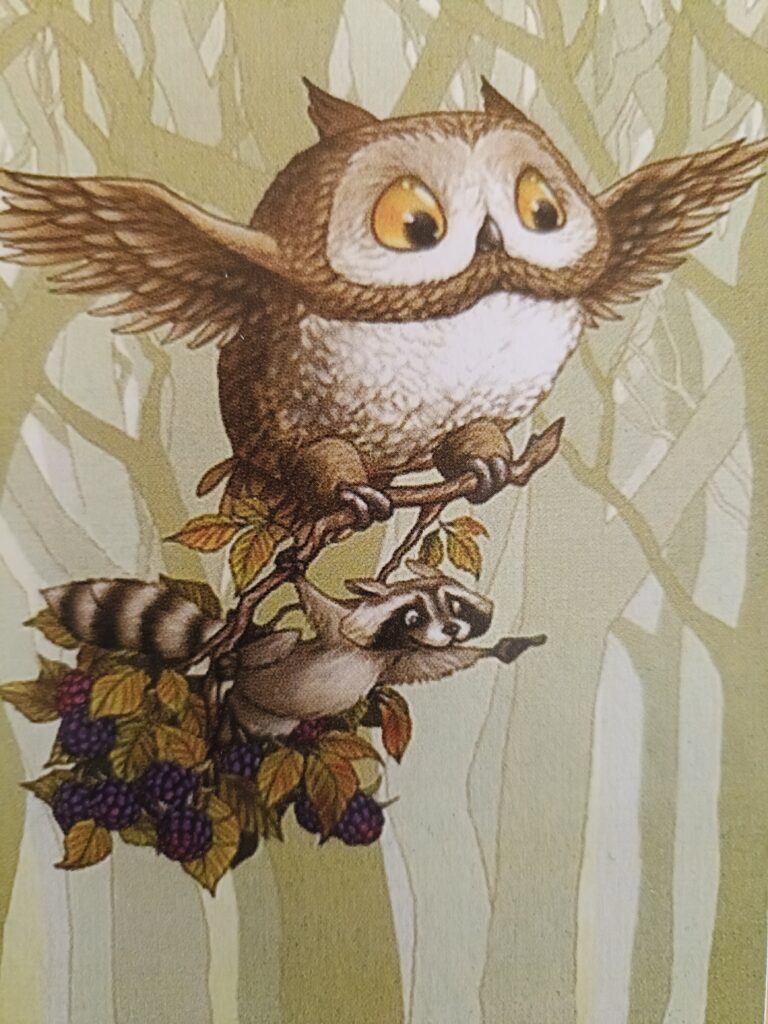
CARD 1: The ambiguity of this card is its strength. The card may illustrate the tension every person experiences between the search for perspective and the need to be grounded. The owl looks up high; it is alert and sees more broadly. The raccoon is lower down, closer to the fruit, closer to “earthly matters,” its instincts, and its desire to acquire. These two attitudes illustrate the tension between spiritual insight and the ordinary needs of life, between meaning and survival, between transcendence and everyday life. This meaning may prompt us to ask: How do I reconcile higher needs with being present in the ordinary realities of life?
The card also shows that different ways of being coexist within a person: wisdom and mischief, solitary reflection and curiosity in the world, seriousness and playfulness. If they can avoid conflict and instead share a single branch—prioritizing the owl’s perspective—then fruit appears on the branch—even against the pale backdrop (the forest) of everyday life. Do I allow such diversity within myself, or do I instead try to reduce myself to just one of these traits? A fragile branch also catches the eye in the card. It serves as a frame for the owl and the raccoon, and may symbolize the human condition—we all stand on something impermanent. Existence has its fragility, and security is never complete. One might ask, in the style of Irvin Yalom: How do I live, knowing that the ground is always shifting a little?
Others, looking at this painting, will say that it depicts the relationship between vigilance and spontaneity. The owl looks like a sentinel, and the raccoon is an explorer. How can I find a balance between control and curiosity, caution and risk in this specific situation? Which part of me watches over life, and which part wants to savor it?
According to Viktor Frankl, we can see meaning in this image—the meaning of sharing a branch. A beautiful existential theme is that meaning doesn’t have to be a heroic discovery. It can simply be being there together. Two beings can interact despite their differences. With Martin Buber, we can exclaim: I am not alone on the branch of my existence.
Wisdom is not the opposite of instinct. Meaning arises when they know how to communicate with one another properly. Which character are you more like today? What gives you wings, and what grounds you? What “branch” do you share with others? How do you reconcile the tension between responsibility and freedom? What in you looks upward, and what seeks fruit?
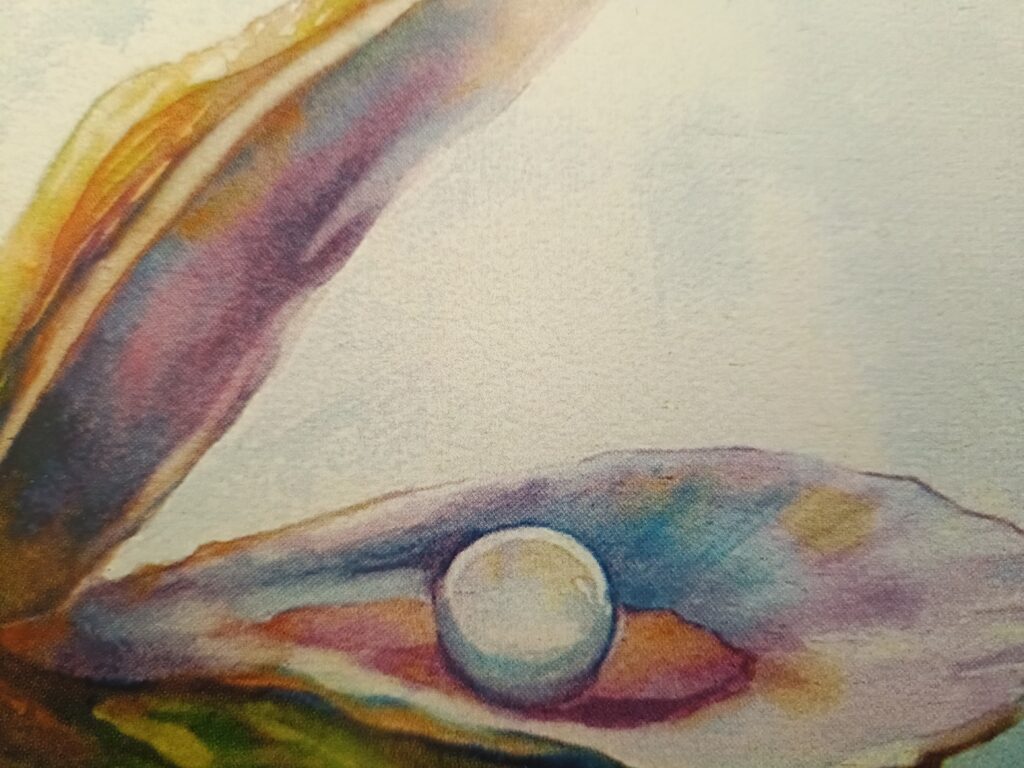
CARD 2: This is a card brimming with existential meaning—few elements, yet a wealth of significance. The shell and the pearl almost beg us to reflect on meaning, suffering, potential, and what “becomes” hidden.
A pearl is born from an irritating grain of sand. If it weren’t for that tiny grain of sand that “causes trouble” for the oyster, no pearl would form. This metaphor is very close to the thinking of Viktor Frankl, who put a great deal of effort into demonstrating a deeper understanding of suffering. Sometimes we discover meaning not in spite of suffering, but through the way we respond to it. Looking at the pearl, which is already the end result of the entire process, let’s ask ourselves: what in my life has matured precisely because of what was difficult?
A pearl isn’t immediately obvious, and to see it, you have to open the oyster—so it is discovered. Carl Rogers spoke extensively about a person’s potential. It cannot be manufactured, because it is something to be discovered. To be able to make use of it, I must bring it to light. What value within me is more waiting to be discovered than to be created? I don’t have to look far; all I need to do is look deep within myself.
On this card, we see that the shell is already open. It’s unclear what fate awaits the pearl—will it fall into the right hands, or might someone unsuitable take it? Uncovering what is like a pearl hidden deep within my soul often involves risk. This metaphor is an encouragement to be vulnerable, to reveal myself, and to take the risk of being authentic. What within me wants to be revealed, even though I’m afraid of it? Am I ready to reveal it? Here, it may also help to consider who I would like to share this knowledge of the pearl with—a pearl that also carries the pain of the sand: what do you think—will your pearl, once “that” person discovers it, end up in the right hands or the wrong ones?
It takes anywhere from a few to even a dozen or so years for such a pearl to form. It cannot be produced by willpower or any kind of pressure. It comes into being through a slow process. Following Rollo May, we might ask: Do I treat life as a project to be controlled, or as something that matures over time? We can achieve goals and call them meaning, or we can help meaning emerge over time and shape our maturation.
Sometimes, in a hurry and based on first impressions, we label people, form beliefs about them, and pass judgment. A seashell looks completely unremarkable on the outside, yet inside it protects a pearl. This metaphor captures many people who, beneath the surface of everyday ordinariness, possess depth and wisdom. No one will ever notice this if they cannot see within themselves the place where the pearl lies. What else have I not yet discovered within myself, because I look only at the outer shell?
All the inspiration for this card can be summed up in this thought: What is most precious is created in secret, without fanfare. Sometimes we carry a pearl where we once saw only a wound. Irvin Yalom would likely add that what is valuable is born of fragility.
In the context of logotherapy, this card is a profound metaphor for human maturation.

CARD 3: This card embodies hope, effort, and the need to rise above, but also the autonomy of a person who makes an independent decision in a unique situation. The first association depicts a person climbing a ladder toward a single star, even though there are thousands of them all around. Why this one in particular?
Elisabeth Lukas wrote that the meaning of life is not an abstract idea “somewhere out there,” but consists of choosing specific possibilities hidden within each individual situation. However, it is impossible to realize all possibilities. A person responds to life by choosing the one that is “right” at that particular moment. Even when we don’t realize it at the moment, in reality, every situation offers various choices, potential paths, desires, and dreams. But a person reaches out toward a single star. Not because the others don’t exist, but because meaning arises from a specific choice.
There is something of freedom in this sense, but also of renunciation. Every choice also means not choosing the other stars. Irvin Yalom would say that freedom is beautiful, but also painful. Am I able to choose one path while accepting the loss of other possibilities? As we can see, this star does not simply fall into our hands—we must climb to reach it. This is not a picture of a dream or of passively waiting for desires to be fulfilled—it is a picture of a real response. Meaning is not given, but realized (V. Frankl). What am I willing to climb for, despite the effort?
If you look closely at the card, you might think: Hmm… It’s interesting that the person looks as if they intuitively know which star to choose. This perspective brings to mind an important insight from Carl Rogers: the body possesses a subtle ability to orient itself toward what is authentically alive. Not all the stars are mine. Which possibilities truly call to me, and which merely impress me?
Life doesn’t require you to reach for every possibility, only that you respond to the one that is truly yours. Meaning is concrete, situational, and unique (E. Lukas). Which star do you need to reach for today? Which possibilities are you afraid of losing? What do you know deep down, even if you can’t explain why? Are you living according to your own star? Which person or cause is that star for you? What is worth striving for in your life?

CARD 4: A lighthouse amid a stormy sea and heavy clouds. But the most interesting thing is that the flame does not appear spontaneously. There is a hand holding a match. Someone is taking action. The sea is not calm, the sky is not cloudless, and the lighthouse does not shine on its own—and yet the possibility of light exists. This is not a picture of harmony. It is a picture of a response to adverse conditions (a phenomenological perspective).
Viktor Frankl would likely point out that a person does not choose all the circumstances of their life, including the storms they’ve weathered, the periods when nothing can be seen beyond the fog, and the moments of darkness. They can, however, choose their attitude toward them. I cannot always change the circumstances, but I can respond to them with my actions or attitude. What kind of light is life demanding of me right now?
It would be easy to say, “I’m not shining because there’s a storm.” Such a statement sounds like giving up and abdicating responsibility. But this card shows exactly the opposite. It is precisely because there is a storm that light becomes necessary (Irvin Yalom). What am I responsible for, even when conditions are not favorable? Am I running away or hiding in situations that require me to take responsibility and take a specific stand?
Looking at this card from a more humanistic perspective, one could say that the lighthouse is a metaphor for the center of my very self, as a person—that which always breathes life into me, that which never falls ill. Life brings all kinds of crises, expectations, moments of feeling overwhelmed, and pressures. It is precisely in these moments, from this deep center of myself, that a question arises: Am I staying in touch with what is alive within me? In this sense, the light does not so much guide others as it first and foremost expresses the authentic existence of the lantern itself.
…but wait, there’s something not so obvious about this card. Whose hand is this? Is it my own action, the help of another person, a therapist, a friend, fate, grace, or the result of some important encounter? Or perhaps, by looking at this “hand from the outside,” I am prompted to ask myself: Do I have to light everything on my own? Am I able to collaborate, to share my knowledge and the fruits of my ideas?
An idea in the spirit of Martin Buber might prove interesting here. Perhaps light does not shine solely through the power of the individual. Perhaps it needs an encounter. Sometimes we find our bearings and the right direction not because we’ve found the answer, but because someone has seen us. In this sense, a hand could symbolize a relationship. Who in my life helps me keep various lights burning? Who supports my light when I can barely see it myself?
We aren’t responsible for the storm, but we can be responsible for the light. The point isn’t to calm the sea—sometimes it’s to light a lantern. This is one of those cards that lends itself very well to a conversation about agency, hope, and responsibility—but without naive optimism, because after all, the storm is very real. And that’s exactly why the light matters.
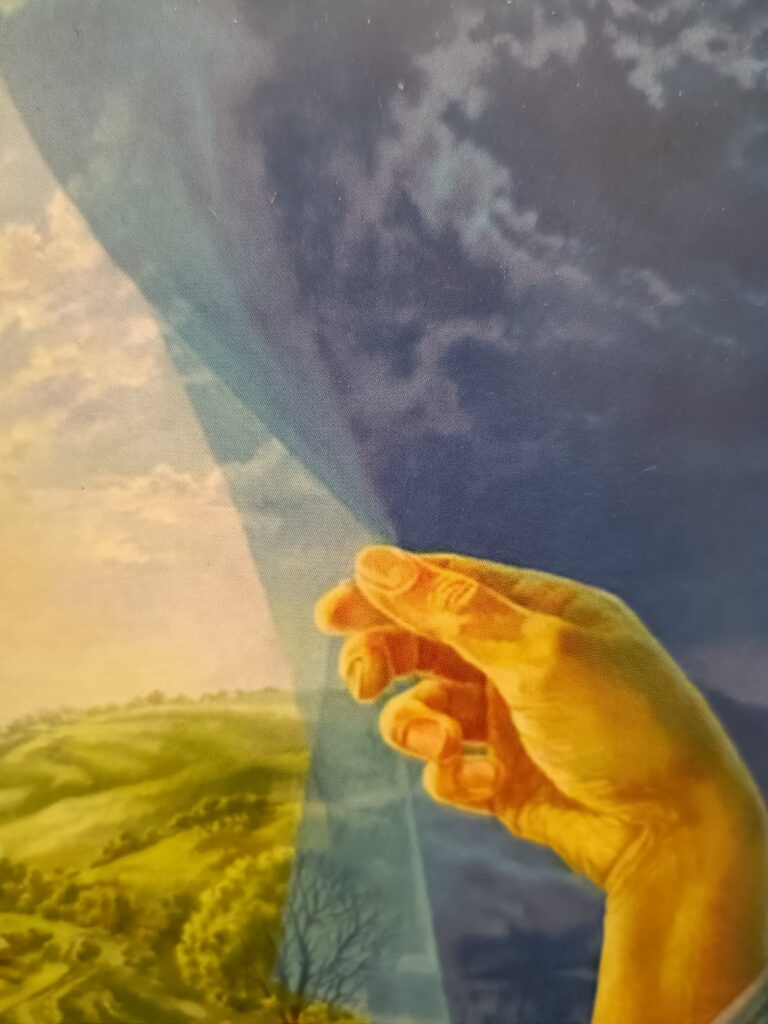
CARD 5: This card makes you linger from the very beginning because it isn’t obvious. At first glance, you might say, “The hand parts the darkness and lets in the light.” But the longer you look at it, the less clear it becomes whether this hand is revealing reality or perhaps choosing which part of it to see. And it is precisely in this ambiguity that its power lies.
This card brings to mind one of Irvin Yalom’s central insights: that a full life isn’t about eliminating darkness. It’s about staying in touch with both the beauty and the tragedy of existence. You can nervously try to live exclusively on the side of light. Or you can get stuck in helplessness on the side of darkness. However, human beings live precisely on the border between the two, and contrary to appearances, the ability to navigate this space gives them balance. Which part of reality am I overlooking today? Have I become stuck in a delusional search for only positive experiences, or in a state of stagnation that condemns my life to permanent lethargy?
From a humanistic and experiential perspective, one wonders whether the card isn’t suggesting that the way we view the world depends on our connection to our own life experiences and how we live them—on the quality of our self-knowledge and self-experience. To some, the same landscape will look like a place of opportunity; to others, a place of danger. Not because the world has changed, but because the way of being in it is different. What kind of world do I experience when I am truly in touch with myself?
Sometimes there are areas within us—values, voices of conscience—that quietly knock on our door, calling for attention and a chance to be heard. When we quiet our minds and give ourselves a moment to listen to ourselves—through a walk, meditation, or prayer—their voices become clearer (Frankl, Lukas). How important it is to draw upon these deep intuitions that are so deeply our own! They emerge from the deepest layers of our being. What possibility for life am I currently trying to allow into my life? Do I give myself time to listen to what pulses at the bottom of my heart with the rhythm of a living spring? What voice emerges from there into my “today”?
A person knows more than they can immediately express (Eugen Gendlin). There is something that can be called a vague yet real premonition of meaning. Looking at this card, it seems that the hand is not so much uncovering a ready-made answer as it is trying to gently touch something not yet named. It is not a gesture of grasping—it is more a gesture of listening. As if someone were saying, “Wait, there’s something there.” What intuition in my life is demanding attention, even though I cannot yet name it?
This card, then, is about the ability to listen to the deepest layers of oneself. Do I possess this ability? What are my strategies for avoiding listening to myself, for avoiding hearing “exactly that”? We cannot always choose the landscape of our lives, but we can often choose what we allow ourselves to look at. And I think that this gesture is the most important thing here. Not light, not darkness, but the person who decides to see and hear more.

CARD 6: This card is, on the surface, the easiest of those we’ve seen so far. It’s easy to say: family, community, joy. But when you look deeper, you see one of the most fundamental themes of existential psychotherapy: a person does not find themselves solely within themselves. On this card, no one is alone. What’s more, no one is at the center. There is no hero, no leader, no figure dominating the image. There is a network of relationships; glances circulate among people, smiles circulate among people. Life circulates among people. This is very important, because contemporary culture tells us, “Find yourself.” Meanwhile, this image seems to ask, “But is it possible to find oneself outside of a relationship?”
A person becomes themselves not in isolation, but through encounter (Buber). There is no pre-existing “self” that later enters into relationships. On the contrary, it is through encounter that the experience of self is born. Who am I because of the people I have met? Who am I with the people I meet? What parts of me exist only when I am with others?
In many places in this image, a certain exchange is visible. What is being given here? Someone is carrying a child, someone is preparing food, someone is listening, someone is laughing, someone is participating. Meaning does not emerge here as an experience, but as participation. This perspective invites us to reflect on Viktor Frankl’s maxim: “Don’t think about what you expect from life. Consider what life expects from you.” What do I bring to the shared table where these “exchanges” take place in my life?
It might seem a little strange given such a cheerful image, but you can also see here that every person is, in some way, ultimately alone. No one will live my life for me, no one will die my death for me. And yet, the greatest relief comes from discovering that I don’t have to bear this loneliness alone. This card seems to illustrate this paradox. As human beings, we don’t need to eliminate existential loneliness, but we have the ability to make it more human.
There is a lot of joy in this card, even though nothing grand is happening. There is no wedding, no victory, no spectacular event. It is an ordinary day. And perhaps that is precisely the point. For most of our lives, we do not live in defining moments—we live in the ordinary. And perhaps one of the most important existential questions is not, “What is the meaning of my life?” but rather, “Can I recognize meaning in what is happening between us right now?” Erich Fromm’s insight may be helpful here; he distinguished between the drive to have and the desire to be. Fromm might say: “The fullest moments of life often do not consist in having something, but in being with someone.” Who am I really with? How do I build this kind of quality of life? How do I nurture it?
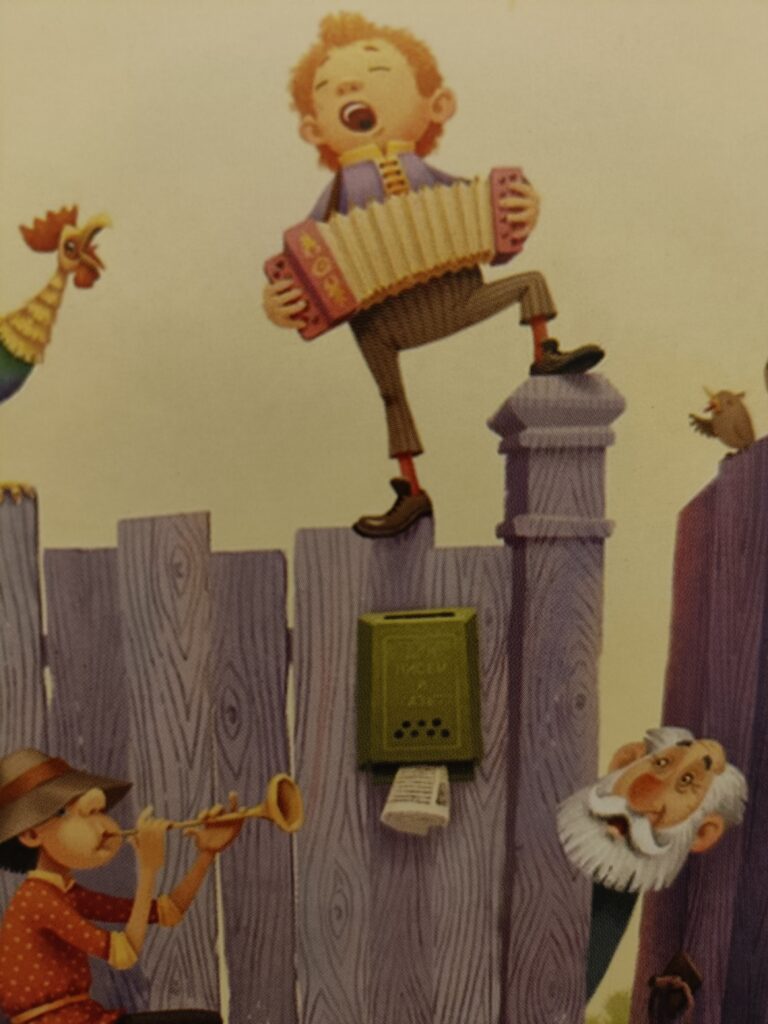
CARD 7: If this card were meant to conclude, for example, a series of group meetings (using the meetings described here in sequence), it seems like an exceptionally apt choice. The previous cards spoke of searching, choosing, meaning, relationships, hope, and responsibility. This card, however, speaks of something else entirely: the courage to be oneself among other people.
At first glance, we see a man who is playing and singing. He isn’t sitting hidden away, he isn’t practicing alone, he isn’t preparing. He is already out in the world. He is visible and audible. And interestingly, he doesn’t look like a professional artist. He looks more like a person who is giving of himself—that’s a very important difference.
Carl Rogers did not write about perfection, but about the process of becoming a person. On this card, we see a man who has achieved the ideal version of himself; we see a man who has stopped hiding—that is a huge difference. Perhaps the most important question posed by this card is: What within me would I want to express if I weren’t afraid of judgment?
Creativity is not the privilege of artists—creativity is a way of being (Rollo May). It is the courage to bring something of one’s own into the world. This boy’s music can be a metaphor for words, decisions, love, work, raising children, and a way of life. It’s not about whether a person plays perfectly. It’s about having the courage to play at all.
Let’s note that others are gathering around us. Someone is listening, someone is peeking through the gate, someone is joining in the music. This is not a solo concert, but a shared event. Martin Buber would probably say that a person does not discover themselves in a monologue—they discover themselves in response to another person. Perhaps this singer would not know who they are if no one heard them.
Notice that throughout all the previous cards, a person was searching for something: a star, light, meaning, a relationship. And here? Here, he is no longer searching—here, he is responding. Viktor Frankl said that the best answer to life is life itself. Is there anything else that paralyzes my courage to live? Am I living to the fullest? What is my music? Perhaps I’m afraid that others will then look at me the way that older man peered through the crack in the gate. But is it worth stifling my music just because others stifle theirs too? Or maybe that “someone” will be inspired by me and believe that they, too, are capable of believing in their own life?
What gives us freedom is the realization that life also means accepting imperfection. This image is a bit playful, a bit frivolous, a bit ordinary. And that is precisely why it is so full of wisdom. Because perhaps maturity does not lie in a person becoming great—but in ceasing to wait for greatness and beginning to participate, here and now, with one’s abilities, just as they are (an existential perspective).
You can analyze your life, know its finest details, and still not live to the fullest. James Bugental has written many times that the most important question isn’t “Who should I be?” but “Am I present in my life?” The person depicted on this card gives the impression of being fully present. He doesn’t analyze himself, doesn’t compare himself to others, and doesn’t prepare for life. He simply lives!
Many existential quests begin with the question, “What is the meaning of life?” and end with a much simpler discovery: “I have my own voice, and I can bring it into the world” (logotherapy). After a profound search, a person does not logically arrive at a ready-made answer. They discover that they themselves become the answer. In the context of the previous cards, this image sounds almost like the finale of a life story: a person no longer stands before a path, no longer climbs toward a star, no longer seeks the light. A person plays their own melody—and that is enough.
III. Methods of using the Described Cards
Method 1
(for personal use)
- For 7 days, set aside at least 15 minutes each day to meditate on each card in turn.
- Make sure you are in a quiet place and under favorable circumstances.
- Look closely at the card (Day 1—Card 1, Day 2—Card 2, and so on). First, think about your intuitions regarding the image. Consider what this card says about you and to you. Let your imagination run wild—there are no wrong thoughts.
- Read and reflect on the interpretation assigned to each card (see above). Pause at each paragraph, reflection, and question, and let them touch your soul. If any of them resonate with you in a special way, take your time; stay with them until you’ve had your fill. You can write down what has arisen within you or move on right away.
- Finally, gather in your mind what was important to you in this exercise. What do you take away as significant, as something that broadens your perspective?
Method 2
(for group use; the cards above, along with their interpretations, can be a great tool for a series of group meetings; with the opportunity for group work, interactions, relationships, and mutual encouragement in the search for and discovery of one’s inner self will also be fostered; this is a very powerful factor)
Number of participants: max. 10; duration of the meeting: 1.5 hours (depending on the number of participants)
- After the introductory part of the session, display the image or show it from the original deck (each session features a different image from the list above, starting with the first one).
- First, ask the participants: What does this image depict? What can you see in it? Then ask: To which areas of life might this image relate? What deeper meaning might it hold (e.g., in terms of relationships, self-perception, a sense of meaning and its fulfillment, etc.)?
- After listening to and gathering the participants’ thoughts, display (or hand out to everyone) the interpretation provided above. Read it slowly (once or twice) and give participants time to listen to themselves in silence. Introduce the following questions: Which part of the text resonates most with me? Which questions or observations make me pause the most or lead me to reflect?
- Turn off the screen displaying the text and image (or ask the participants to set aside their interpretation sheets). Turn to one another in a circle. Encourage everyone to individually express their thoughts and experiences from this exercise. You might use words like these: We’ve touched on deep places that we all carry within us, but we don’t always have the opportunity to hear or express them. We’re in a safe space and a confidential group, so we have the freedom to share what resonated with us regarding today’s card. What did you hear here—personally to yourself or about yourself? Does this card invite you to do something, or shed light on something for you?
- Finally, you can ask the participants to share: What are they taking away from others’ responses? What inspired them or deepened their reflection?
IV. Methods for individual Work
METHODS FOR WORKING WITH ENTIRE DECKS (135 + 150 cards)
Method 1 “Dialogue with the Card”
This is a phenomenological method in which the focus is not on interpreting the image, but on encountering it.
- The participant chooses a card intuitively.
- Then they look at it for one minute.
- The facilitator asks, “What catches your attention the most right now?” (They don’t ask “what does it mean,” but “what draws you in”—focusing on the experience)
- Next, the following questions may be asked: What is happening in this image? Where are you in this image? Where would you like to be? Where is this image leading you? What is missing from it? What remains unsaid?
Method 2 “Lifeline”
This exercise was inspired by “Autobiography Spread Out Over Time”—a form of therapeutic group process developed by Elisabeth Lukas.
Participants in the exercise select six cards that best reflect their associations with specific stages of life:
- the card of childhood
- the card of youth
- the card of his current life
- the card of the future
- the card he fears the most
- the card he would like to reach
When discussing the stages of life, we do not analyze the chronology, but rather examine how a person’s way of life changes, what existential questions it raises, and what challenges it presents.
Method 3 “A Conversation Between Two Cards”
A person chooses two cards.
- One that captures the sentiment: “This is who I am today.”
- The other: “This is who I’d like to be.”
Next, the therapist places them facing each other. The therapist models a dialogue between the cards, which the client leads. The direction of the “conversation between the two cards”: What would the first card say to the second? Then the reverse. At the end, depending on the flow of the conversation, you can ask: Which card is telling the truth?
In this exercise, after the initial questions from the dialogue between the cards, the participant can be encouraged to switch to leading the conversation in the “I” form.
V. Methods for Group Work
METHODS FOR WORKING WITH ENTIRE DECKS (135 + 150 cards)
Method 4 “A Shared Map of Meaning”
The entire group, using about 20–30 cards, collaboratively formulates an answer to the question: “What is a good life?”
After the cards have been selected and arranged in any order, the facilitator initiates a discussion about such a life, highlighting the values that emerge during the discussion. There is no single correct answer in this exercise. Its purpose is to encourage reflection on the areas of values and meaning.
Method 5 “The Existential Circle of Encounter”
This is a profound exercise that requires some experience working with people. It is not based on interpreting images, but on four successive stages that correspond to how a person matures toward an authentic response to life. Each participant chooses a card that intrigues them. The facilitator explains that they do not need to interpret the card or fully understand it. After the cards have been selected, the facilitator guides the group through the successive stages of experiencing the image:
- See—what moves me about this image?
- Experience—what happens inside me when I look at it?
- Name—what aspect of my life does this image speak to?
- Respond—what action or attitude does this card invite me to take?
This exercise best illustrates that Metaphor Cards are not merely a tool for interpretation, but rather tools that guide a person from an image, through experience, to an existential answer. This perspective is faithful to the ideas of Viktor Frankl, Irvin Yalom, and Carl Rogers, while also proposing its own coherent methodology.
VI. Additional Methods (Bonus!)
METHODS FOR WORKING WITH ENTIRE DECKS (135 + 150 cards)
It’s worth mentioning a few more general methods here, from which the therapist chooses the one that best suits a given card and person. In some cases, the therapist will choose a specific card to work with; in others, they will suggest one to the participant.
Method 6 “Seven Voices” — one card, seven thinkers
The participant chooses one card, and the facilitator can lead a discussion inspired by various psychological and philosophical traditions in turn. It is not necessary to use all seven. The therapist selects the ones that “fit” the given card.
- Karl Rogers – authenticity: What in this image most closely matches what you’re actually experiencing?
- Elisabeth Lukas – values: What possibility for living does this image draw your attention to?
- Irvin Yalom – freedom and responsibility: Where in this situation do you find your freedom, and where do you find your responsibility?
- Martin Buber – Encounter: Who or what do you really need to encounter here?
- Eugene Gendlin – Experience: What do you feel in your body when you look at this image?
- Rollo May – Courage: What would it take for you to courageously step into this situation?
- Viktor Frankl – Meaning and Acceptance of Life: What in your current life do you find it difficult to say an inner “yes” to? Why would you like to say it?
Method 7 “Before—Now—After”
The participant selects three cards that may relate not so much to events as to ways of being associated, in turn, with the past, the present, and the future. The same questions we’ll use shortly to discuss the images can help with this selection:
- Before: How did I live?
- Now: How am I?
- After: Who can I become?
You can ask an additional question that proves particularly relevant when working with identity and change: What must remain the same for me to still be myself?
METHODS AVAILABLE AT THE KRAKOW INSTITUTE OF LOGOTHERAPY
- Four Existential Questions
- My Inner Landscape
- The Card That Doesn’t Like Me
- The Card That’s Waiting for Me
- The Meaning Hidden Between the Pages
- The Existential Chair
- The Untold Life
- The Circle of Meanings
- The Hero’s Journey
- A Card for Another Person
- Four Existential Questions
- Three Perspectives
- Opportunities in the Sky
- A Card Like a Mirror
- One card, many truths
- A Method Above All Methods
AVAILABLE HERE: